
Exploring Silicon Photonics for Future Networks: Insights from BT and the CORNERSTONE Photonics Innovation Centre
BT Group is modernising the UK’s communications infrastructure while preparing for a future of quantum-safe, high-speed and highly secure networks. Silicon photonics (SiPh) and photonic integrated circuits (PICs) are central to this shift, offering compact, energy‑efficient and scalable platforms that can support both classical upgrades and emerging quantum‑safe capabilities across BT’s vast network footprint. Within BT’s Research Network Strategy division, Dr Zoe Davidson is leading efforts to understand where integrated photonics delivers the most value – from improving access‑network efficiency to enabling on‑chip quantum key distribution (QKD) modules that fit real‑world operational and security requirements.
This case study examines how collaboration with the CORNERSTONE Photonics Innovation Centre (C‑PIC) helps BT turn these photonics concepts into deployable hardware. Joint projects such as the Innovate UK‑funded QAssure programme – where Davidson, C‑PIC and academic partners are developing SiPh QKD user modules for secure access networks – demonstrate how this ecosystem accelerates the path from lab design to telecom‑grade evaluation.
By combining BT’s network‑level vision with C‑PIC’s infrastructure, training and design enablement, this partnership lowers barriers to adopting PIC technologies in critical communications systems. Initiatives like PIC Bootcamp build practical skills inside BT, while Davidson’s role on C‑PIC’s Industry and Scientific Advisory Board ensures that carrier‑grade requirements directly shape future SiPh platforms. Together, BT and C‑PIC are creating a feedback loop in which photonics infrastructure and real‑world deployment needs evolve in tandem – helping ensure that tomorrow’s UK networks are more resilient, energy‑efficient and quantum‑safe by design.
A foundation of the UK’s communications infrastructure, BT Group plays a pivotal role in both maintaining and advancing the nation’s connectivity. In an era of accelerating technological change, BT is continuously modernising legacy networks for homes and businesses while exploring cutting-edge solutions like quantum-safe communications, integrated photonics, and secure network design.
A core enabler of this strategic evolution is silicon photonic (SiPh) solutions, or more specifically photonic integrated circuits (PICs) – compact, scalable platforms that integrate multiple optical functions on a single chip. These technologies are increasingly vital to meeting the scale, efficiency, and resilience required for high-speed and secure network systems.
As a Research Specialist at BT, Dr Zoe Davidson has played a key role in exploring how SiPh can support the company’s long-term infrastructure strategy. To help realise this vision, she has worked closely with the CORNERSTONE Photonics Innovation Centre (C-PIC) – the UK’s dedicated technology hub for SiPh innovation.
Based at the University of Southampton, C-PIC is a 5-year programme involving the Universities of Southampton and Glasgow, alongside the UK’s Science and Technology Facilities Council (STFC). It provides open-access design tools, fabrication, and expertise to accelerate photonics adoption across academia and industry. In this article, we explore how Davidson and C-PIC are helping to bring next-generation photonic technologies from concept to deployment, forming a vital bridge between research and application that supports BT’s evolving network strategy.
Strategic Research, Network Focus
BT’s Research Network Strategy division is tasked with anticipating the future of networked communications. The team blends long-term forecasting with experimental research in areas spanning optical networking, quantum technologies, artificial intelligence (AI), cyber security and cloud infrastructure. It ensures BT’s networks remain agile, secure and capable of enabling future technical shifts.
Zoe Davidson is part of this division, where her focus lies in identifying how photonic technologies, particularly integrated platforms, can support the goals of future-proofing BT’s infrastructure. The substantial infrastructure supported by BT demands a correspondingly broad research remit. This means its teams explore everything from new cryptographic methods and machine learning (ML) approaches for traffic optimisation, through to the application of quantum algorithms that could solve complex network planning problems.
However, this breadth is underpinned by a singular focus: how each technology can serve the end goal of more resilient, efficient and secure networks. To achieve this objective, BT draws upon a wide ecosystem of global technology suppliers and collaborators, regularly evaluating and integrating cutting-edge vendor solutions. But this forms only part of BT’s approach. The group also undertakes its own targeted research when commercial offerings are not yet mature or fully aligned with network demands. This dual approach ensures agility – allowing BT to adopt proven technologies where available while shaping or advancing emerging capabilities when necessary.
It is within this context that photonics comes to the forefront. PICs offer a route to scalable, energy-efficient systems capable of supporting classical and quantum-safe functions alike. Their small form factor, low power consumption, ease of manufacturing and design, and suitability for integration make them particularly attractive in a network environment.
BT’s collaboration with C-PIC provides a key avenue through which PICs can be trialled and integrated into real-world telecom environments. C-PIC’s open-access model and emphasis on rapid prototyping ensure that BT’s teams can test concepts quickly and learn iteratively, helping them remain at the forefront of network innovation.
Photonics in BT’s Network
Within BT’s research environment, integrated photonics is being explored as a scalable, low-power alternative to traditional optical systems – supporting both classical upgrades and emerging network capabilities. In the classical domain, Dr Zoe Davidson and her colleagues are often focused on the access layer of the network, where economic and performance constraints make it impractical to deploy traditional solutions that rely on active gain components such as III–V semiconductor amplifiers. In these settings, PICs offer a compact and efficient platform capable of improving signal handling and wavelength management while reducing cost and complexity.
“At BT, we’re focused on using photonics where it delivers real value – whether that’s energy efficiency, compact integration, or enabling quantum-safe functions in the network.”
– Dr Zoe Davidson, BT
On the quantum side, BT is actively involved in the UK’s broader innovation effort, recognising quantum technologies as essential to future network resilience and security. While BT does not aim to build quantum computers, it explores quantum applications where they intersect with communications infrastructure – for example, using quantum algorithms to optimise routing and planning, or integrating quantum key distribution (QKD) into secure access networks.
One such initiative is QAssure, an Innovate UK-funded programme seeking to establish a formal assurance framework for QKD – an area that currently lacks standardisation and regulatory clarity. As part of this project, Dr Davidson has collaborated with the University of Bristol and C-PIC to design and fabricate on-chip QKD user modules using SiPh. These modules, produced through one of C-PIC’s MPW runs, are now undergoing laboratory testing as part of efforts to assess their suitability for real-world deployment.
BT’s use of integrated photonics reflects a forward-looking, application-driven approach in which technologies are assessed for their alignment with operational and strategic needs. Photonics are a key tool within this landscape and are deployed where they provide clear advantages in performance, security or energy efficiency.
C-PIC’s services have been key in supporting these efforts. C-PIC’s combination of technical expertise, design support and accessible MPW prototyping allows BT to move rapidly from concept to testable hardware, shortening development cycles and facilitating early evaluation. This UK-based capability is particularly valuable in contexts where domestic fabrication is preferred or required, such as in critical network infrastructure.
Working with C-PIC: Lowering Barriers, Driving Adoption
C-PIC serves as the UK’s national hub for SiPh – providing open-access prototyping, fabrication, training and design support for researchers and companies across sectors. Its mission is to lower the barriers to entry for PIC technologies and support a pipeline of SiPh development, promoting industrial adoption through collaborative R&D.
One initiative supported by C-PIC, alongside the University of Bristol, Wave Photonics, Bay Photonics, and Anchored In, is PIC Bootcamp, a hands-on training programme that enables participants to design, simulate and prepare a PIC for MPW submission in just six days. Dr Zoe Davidson participated in the 2024 PIC Bootcamp, highlighting its value in helping engineers gain practical experience with PIC design and fabrication.
“I already had a PhD in integrated photonics, but the Bootcamp gave me hands-on design experience – taking a chip from concept to fabrication-ready in days. It really added to my practical skill set.”
– Dr Zoe Davidson, BT
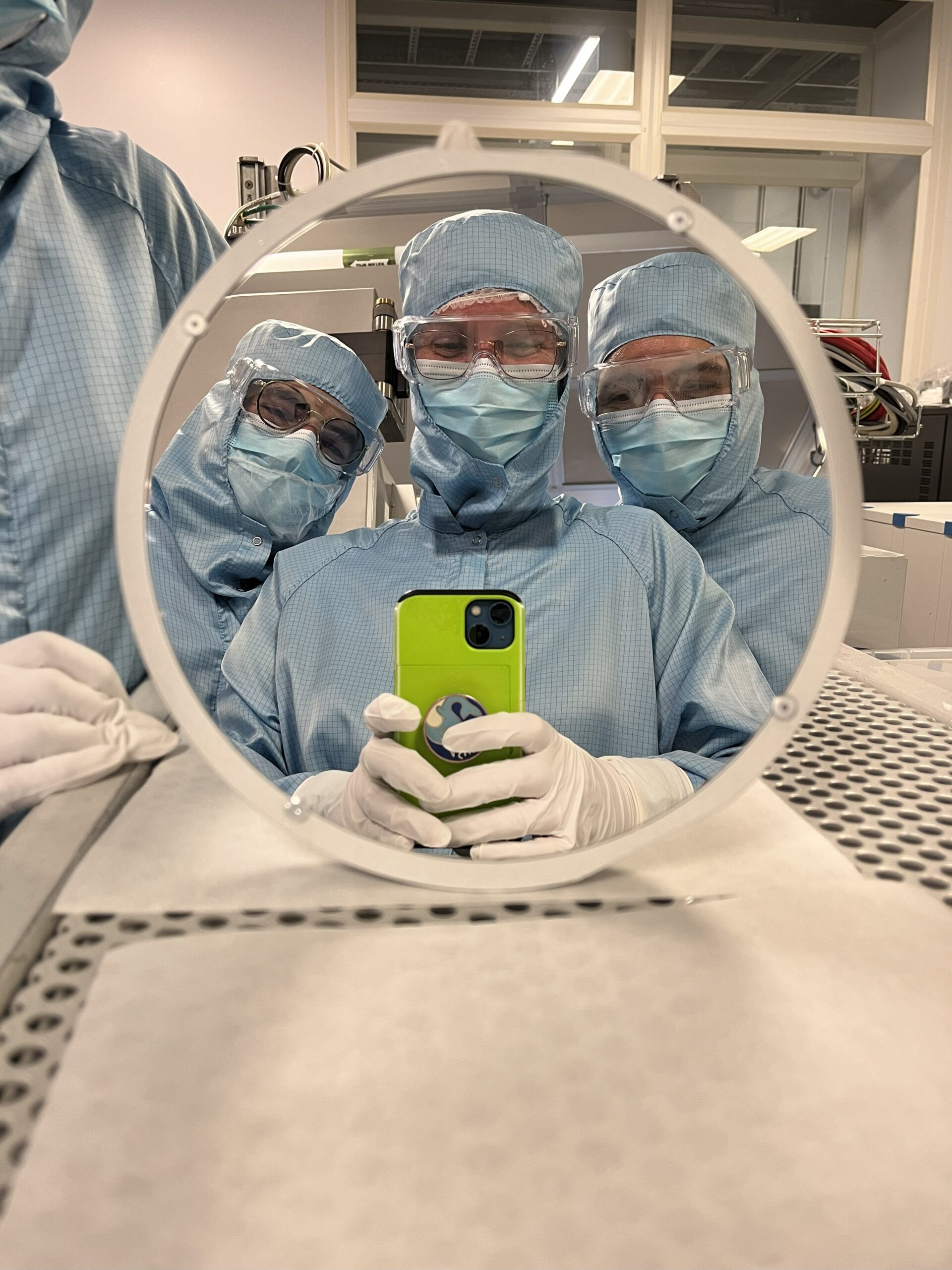
Although her PhD and industry experience provided a strong theoretical grounding in integrated photonics, the Bootcamp offered a hands-on opportunity to deepen her understanding of the full design-to-fabrication process. Using open-source design tools, participants learn how to simulate, lay out, and prepare a chip for MPW submission – skills that Davidson has since applied to her work on the QAssure project with BT.
Beyond MPW runs and training, Davidson also plays a key role in shaping C-PIC’s industry engagement, serving as Chair of its Industry and Scientific Advisory Board. This role ensures that insights from BT and other industrial stakeholders directly inform the evolution of C-PIC’s services and SiPh platforms – aligning technical capabilities with real-world deployment needs.
Looking Ahead
C-PIC plays a foundational role in the UK’s SiPh ecosystem – providing open-access fabrication, design enablement, and expertise that accelerate adoption across industry and academia. By lowering the barriers to PIC development, it allows organisations like BT to move rapidly from concept to evaluation.
As BT continues to shape its approach to quantum-safe infrastructure, the role of integrated photonics is set to grow. Technologies under trial today, many developed with C-PIC, will underpin the systems of tomorrow.
However, this is not a one-way relationship. As C-PIC provides infrastructure, tools, and training, companies like BT contribute practical challenges and deployment insights, helping to create a UK photonics landscape that is agile, secure, and aligned with market priorities.